Blog

Engineering articles

Articles on AI automation, implementation economics, workflow ROI, manufacturing quality control, and practical AI adoption.

Latest articles

A report panel with sheets, a clock and a check mark.

How to Automate Production Reports from ERP Exports

A walkthrough that starts from a finished, illustrative daily production report and traces every number back to three ERP exports: production confirmations, open orders and a downtime log. It covers the grain and keys of each export, why a row-level join on line and shift doubles stop minutes and how aggregating first fixes it, exact rules for exceptions and late orders, refresh and shift-lead sign-off, and the usual ways the report breaks.

Pavel Krieger

Four cameras pointing to a central image panel.

Video Analytics vs Machine Vision: Which Cameras Does Your Plant Need?

A side-by-side comparison of video analytics on network or CCTV cameras and machine vision on industrial cameras: lens, mounting and light, frame rate, interfaces, accuracy limits, where each runs, what each sends to other systems and what drives cost. It maps common plant jobs to each approach, separates RTSP from ONVIF, gives a seven-point check for reusing existing cameras for production monitoring, and sets out EDPB guidance on purposes, signs and retention.

Pavel Krieger

Document sheets connected through a processing block, with check marks beside the outputs.

Compliance Automation ROI in Manufacturing: Audit Prep, Traceability and Quality Records

Plant compliance is mostly records work. This worksheet prices it line by line: certificates of conformance, audit prep, traceability requests, holds and findings avoided, build cost and running cost. An assumed example works through to a 44% year-one ROI and payback in about 7.7 months, with best, base and worst cases beside it. It ends with what to automate first, the sign-offs that stay with a named person, and the validation, data integrity and retention risks.

Pavel Krieger

Shipping boxes and price tags beside a teal bar chart with one amber bar.

AP Automation ROI for Manufacturers: Why the Exception Rate Decides Payback

A lever analysis of accounts payable automation ROI for a manufacturer. In an illustrative model with 1,000 PO-backed invoices a month, the share of invoices that still fail the three-way match after go-live decides payback: month 11 at 10%, 13 at 20%, 19 at 30% and 44 at 40%. The article gives the formulas, the inputs, each lever's effect, the plant causes of match exceptions and the costs business cases leave out.

Pavel Krieger

Two Excel tables with highlighted differences.

How to Compare Two BOM Revisions in Excel

A short Excel tutorial built on one small sample. Clean an MPN key, compare two BOM revisions with XLOOKUP formulas or a Power Query full outer join, and expand designator ranges such as R1-R4 before comparing designators. Then pair a removed and an added line at the same designator as one replacement, and check quantity against designator count and DNP lines.

Pavel Krieger

An isometric rocket rising from stacked teal platforms, with a small amber marker beside it.

Release to Manufacturing (RTM): What It Means in Software and in Hardware

A glossary of release to manufacturing (RTM) terms. Software: release candidate, RTM, going gold, general availability, RTM vs GA, and go-live in a running plant. Hardware: EVT, DVT and PVT as common usage rather than a standard, a table of the release package for a PCB assembly, and ECR, ECO and ECN change control. It also separates an ERP production order release from a design release and answers five practical questions.

Pavel Krieger

A machine controller with an orange button connected by a cable to a server stack.

How to Connect CNC and Legacy Machines to Your ERP: A Reference Guide

A shop-floor reference guide for connecting CNC and legacy machines to an ERP. Its tables cover the data each machine type can share and the usual collection path, compare MTConnect with OPC UA, and separate ERP events from signals that stay local. It explains how a machine count becomes an ERP quantity, with quality confirmation, work-order matching, resets and network outages accounted for, then closes with basic CISA-aligned security checks and a machine inventory template for a small pilot.

Pavel Krieger

A component chip beside a data record and cost chart.

Electronic Parts Data Management for Small EMS and OEM Teams

A reference for small EMS and OEM teams: the minimum fields each part record needs, a catalogue of common BOM errors with the check that catches each, a 16-step scrub checklist to run before an RFQ, a decision table for spreadsheet, parts database or PLM, and four rules for keeping part data fresh.

Pavel Krieger

Teal conveyor carrying three blocks, with rising amber bars and a curved trend line above.

Manufacturing Analytics for Small Plants: Excel, Power BI or Custom Software?

A comparison of five manufacturing analytics options for plants with 20 to 500 people: ERP reports, Excel with Power Query, a BI tool such as Power BI, machine monitoring and custom software. One table sets them side by side, and short sections say when each next option is worth it, with Power BI prices, licensing and refresh limits checked in 2026. It ends with common KPI formulas, an OEE check and five reasons analytics projects stall.

Pavel Krieger

Two interlocking teal gears beside a clock face, lit by an amber glow at their connection.

A new paradigm on established economics: multiplicative cost optimization in business operations via labor savings and cycle-time reduction with AI

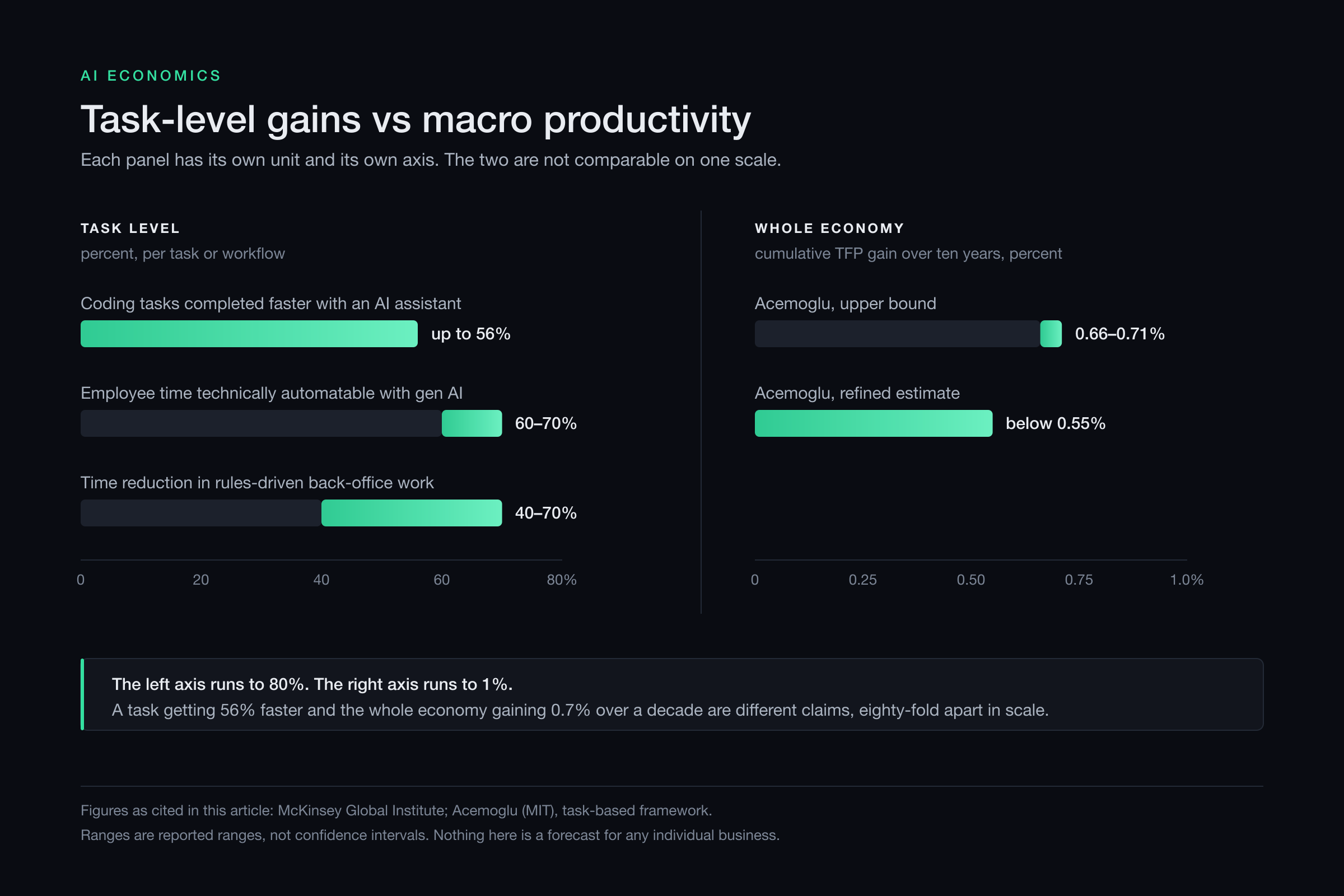
Artificial intelligence is shaping a new economic paradigm that promises a path to cost optimization by multiples through task automation and higher labor productivity. McKinsey estimates generative AI could add the equivalent of $2.6–$4.4 trillion annually to the global economy—raising the impact of AI and analytics by 15–40%—with banking, high tech, and life sciences among the largest beneficiaries as a share of industry revenue.

Pavel Krieger

A winding teal route with ten circular milestone nodes, one marked by an amber decision point.

10 Steps to Developing an Effective AI Implementation Roadmap

A ten-step AI implementation roadmap for mid-sized, non-tech firms, with examples from manufacturing plants. Define one measured problem and its root cause, score readiness on six dimensions, write a business case with a realistic payback horizon and fix the data. Then judge a contained pilot against mandatory gates and pre-agreed criteria, scale only what passes, and keep governance, retraining and training in the plan. Includes a pilot evaluation form and RAND's five root causes of AI project failure.

Pavel Krieger

Isometric payback path: tiles sit below a break-even line during payback, cross at a marked node, then rise above the line as returns accumulate

Calculating the True ROI of Workflow Automation

A strategic briefing for finance leaders on workflow automation ROI. It sets out a five-step framework, the correct ROI and payback formulas, and benchmarks traced to Deloitte, Ardent Partners, the BLS and published research. A worked model for a 120-person contract electronics manufacturer, with every input stated as an assumption, shows a negative first year, payback in month 15 and a 112% three-year ROI, and shows why the size of the invoice you can cancel, not the automation rate, decides the result.

Pavel Krieger

Isometric inspection line: identical parts travel under a scanning beam, one part is lit as it is inspected, and one part is diverted below the line

How AI is Transforming Manufacturing Quality Control

An industry report on AI quality control in manufacturing. It sets out official adoption data from Eurostat and the U.S. Census Bureau, what research has measured about human inspection and AI defect detection, typical inspection tasks in automotive, electronics, pharmaceutical and food plants, what drives cost, how to validate and secure a system, what to require from a supplier, and a three-phase rollout that starts with a one-station pilot in shadow mode.

Pavel Krieger

Separate teal blocks join connected modules across a structural bridge with an amber connection point.

Implementation Consulting: Your Bridge to AI Success

Many AI projects stall between prototype and production. This essay argues that implementation, not strategy, decides whether AI pays off in manufacturing and other physical industries. It traces how the big consulting firms moved toward building, reads two documented cases with their limits stated, and then takes a position: the three conditions under which an outside builder is genuinely needed, the three that have to hold together before your own team is enough, and the four responsibilities that cannot be handed to a supplier at any price.

Pavel Krieger

Explore

Have a process, dataset, or camera footage to work from?