Guidance for Project and Strategic Managers of Mid-Sized, Non-Tech Enterprises
Before diving into details, key take-aways:
- Start from one costly, measured problem with a named owner, not from a tool.
- Success hinges on groundwork more than on algorithms. In BCG’s 2024 study, AI leaders follow a rule: 10% of resources go to algorithms, 20% to technology and data, and 70% to people and processes.1
- A phased, low-risk approach keeps each bet small: one contained pilot, judged against criteria agreed in advance.
Below is a structured playbook for firms of 20–500 employees in traditional industries, with examples from plants.
1. Define Vision & Success Metrics
- Align AI ambitions with a goal the business already tracks (scrap, unplanned downtime, hours spent retyping supplier documents), stated with a number and a date.
- Select one or two “North-Star” KPIs, not vanity metrics, and measure their baseline before anyone builds anything.
- Find the root cause first. Before a plant invests in an AI vision system for defects, NIST’s Manufacturing Extension Partnership suggests “a thorough root cause analysis using existing data and human expertise.”2 Sometimes, it notes, “a checklist, standardized procedures, or training might be all you need to solve the problem.”
- Appoint an executive AI sponsor, a cross-functional steering group and a business owner who feels the problem every week.
2. Readiness Assessment
- Evaluate gaps across six dimensions: strategy, data, systems, people, governance and measurement. Score today and the target for each from 0 (not started) to 5 (leading), then close the gaps that block the first pilot.
- Use a lightweight questionnaire, or a formal model such as MITRE’s AI Maturity Model.3
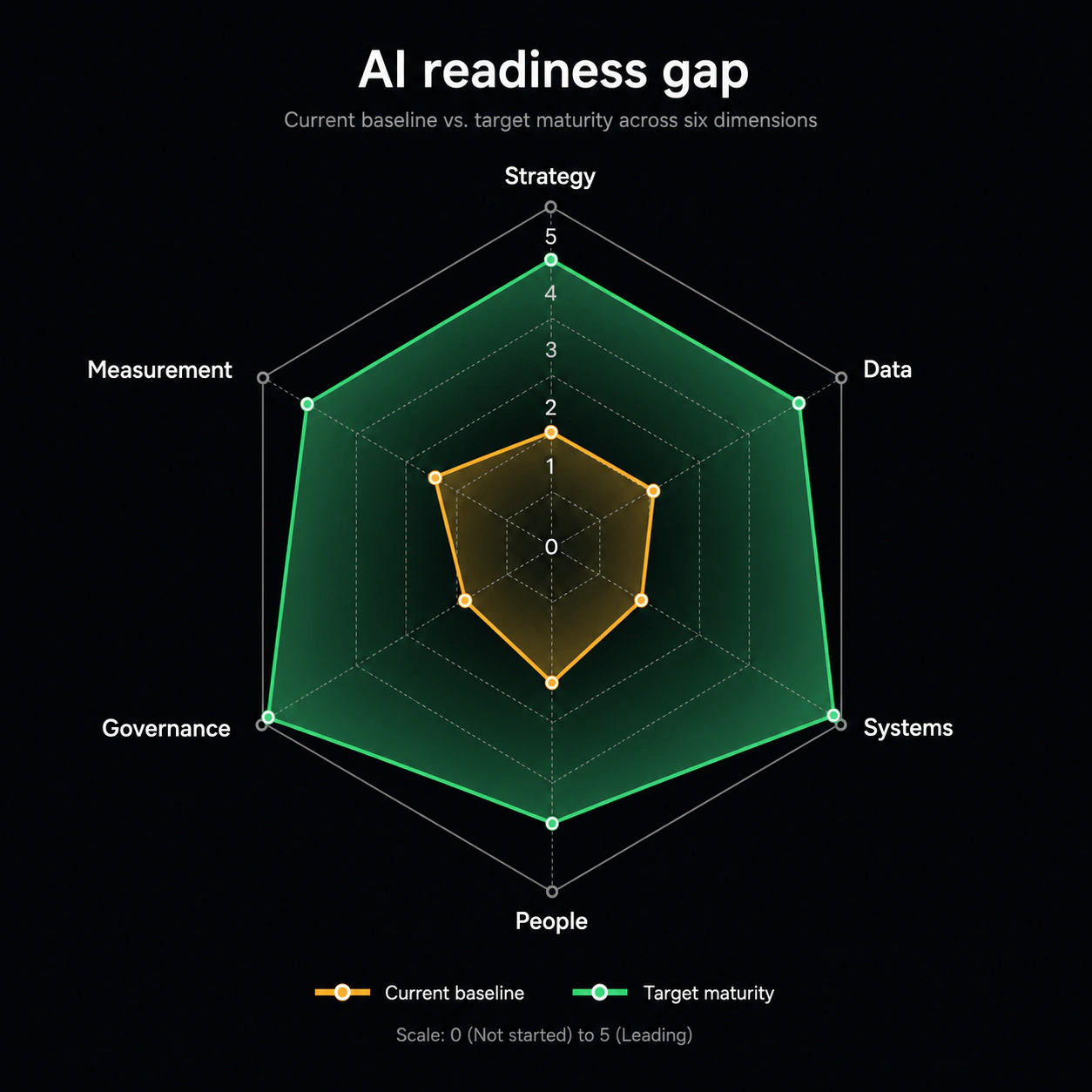
Figure 1. Illustrative readiness gap: an example current baseline against a target maturity on a 0–5 scale across strategy, data, systems, people, governance and measurement. The values are illustrative, not measured.
3. Build a Business Case
| Element | What to write down | Why |
|---|---|---|
| Problem cost | Today’s cost from the step 1 baseline | Caps the possible return |
| Expected change | A low, middle and high case | Shows how much rests on assumptions |
| One-time cost | Build, integration, hardware, data cleanup, staff time | Funds the pilot and production |
| Running cost | Hosting, licenses, support, time spent checking outputs | Often missed; decides if the case holds |
| Payback month | When cumulative net savings cover the one-time cost, per case | Compares it with other uses of money |
| Riskiest assumption | The one that sinks the case if wrong, as a test with a number | Tells the pilot what to measure |
In Deloitte’s 2025 survey of 1,854 executives in Europe and the Middle East, most respondents reported satisfactory ROI on a typical AI use case within two to four years. Only 6% reported payback in under a year.4 If the low case does not pay back within a horizon your owners accept, shrink the scope or pick another problem.
4. Establish Data Foundation & Governance
- Inventory the data and pull a real sample: ERP or MES exports, line-camera footage or supplier documents. Check that history exists, that outcomes are labeled (bad parts, stop reasons) and who controls access.
- Know a metric’s inputs before you promise it. OEE needs planned production time, run time, ideal cycle time, and total and good counts.5 Machine run and stop states, with the shift plan, give availability, not full OEE.
- Implement a minimal data platform: an SQL database fed by scheduled exports is often enough at first.
- Draft an AI ethics and security policy. ISO/IEC 42001 sets requirements for an AI management system.6 In the EU, check which of the AI Act’s four risk levels each use case falls into.7
5. Launch a Low-Risk Pilot Project
Criteria for a good first pilot:
- Clear, measurable payoff (e.g., label print inspection on one packaging line).
- Data available internally.
- Deployment contained (one line, one cell or one desk).
- Success measurable in under three months.
Set up the four gates from step 6 before the start. Run in shadow mode: the system makes a call, a person decides, and you compare the two. Use SaaS or low-code tools for common tasks such as invoice capture; build when the task depends on your own parts, lines or documents.
6. Evaluate & Iterate
- Check four mandatory gates: a named business owner; acceptance criteria written and signed before the start; a baseline measured on the same sample set; a person checks every output during the pilot. If any gate is NO, the pilot result cannot be judged.
- Measure actual vs. target weekly against the signed criteria, without moving the goalposts.
- Decide: go, fix and re-test, or stop. Any failed criterion leads to fix-and-re-test or stop, never to “go.”
- Document lessons learned: technical misses, adoption barriers and skills gaps.
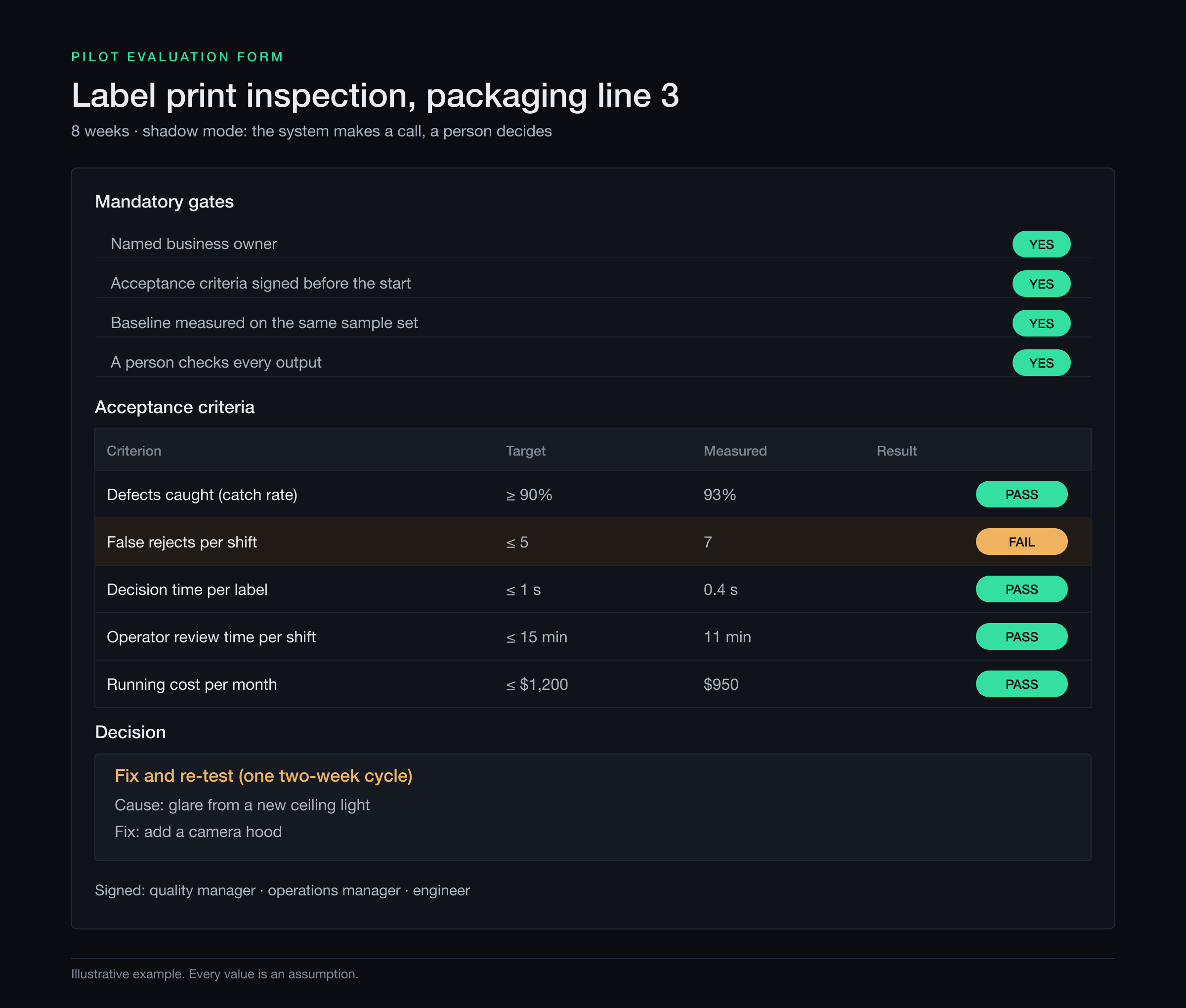
Figure 2. A filled pilot evaluation form (illustrative example; every value is an assumption).
The form shows an illustrative pilot: label print inspection on packaging line 3, eight weeks in shadow mode. All four gates are YES. Four of five criteria pass; false rejects fail at 7 per shift against a limit of 5, caused by glare from a new ceiling light. The quality manager, operations manager and engineer sign the decision: add a camera hood and re-test in one two-week cycle.
A blank version to copy:
| Item | Target | Measured | Result |
|---|---|---|---|
| Pilot and duration | |||
| Gate: named business owner | YES / NO | ||
| Gate: acceptance criteria signed before the start | YES / NO | ||
| Gate: baseline measured on the same sample set | YES / NO | ||
| Gate: a person checks every output | YES / NO | ||
| Criterion 1 | PASS / FAIL | ||
| Criterion 2 | PASS / FAIL | ||
| Decision: go, fix and re-test, or stop | |||
| Cause and fix | |||
| Signed by |
7. Scale Successful Use Case(s)
- Extend to additional lines, plants or business units one at a time, once the pilot runs in production.
- Transition from shadow IT to a managed setup (DevOps, MLOps pipeline): results reach the MES, ERP or a line screen, with monitoring, versioned releases and rollback.
- Agree a definition of done before that build; acty.dev’s process does the same.
- Update SOPs and train frontline employees for when the system flags a part and when it is down.
8. Integrate Risk & Ethics Governance
- Formalize model risk management: validation on a hand-checked sample before each release, bias checks where outputs affect people, and drift monitoring.
- Update data-protection impact assessments when a system touches personal data, such as camera footage of workers.
- Establish a small AI oversight group with legal, HR and operations representation to approve new use cases.
9. Optimize & Automate Processes
- Combine AI with RPA or IoT for closed-loop automation: a confirmed label defect diverts the carton and logs the reason in the MES. Keep a person in the loop where an error could reach a customer or affect safety.
- Use continuous data collection to retrain models on a schedule, such as quarterly, and sooner when new label artwork or a moved camera makes results slip.
- Benchmark against your own baseline first, then against published industry cases.
10. Continuous Improvement Culture
- Launch an internal “AI Academy”: short sessions on the tools people use, plus a deeper track for future model and data owners.
- Budget yearly for running costs (monitoring, labeling and retraining), not only for new projects.
- Refresh the roadmap annually; sunset low-value models.
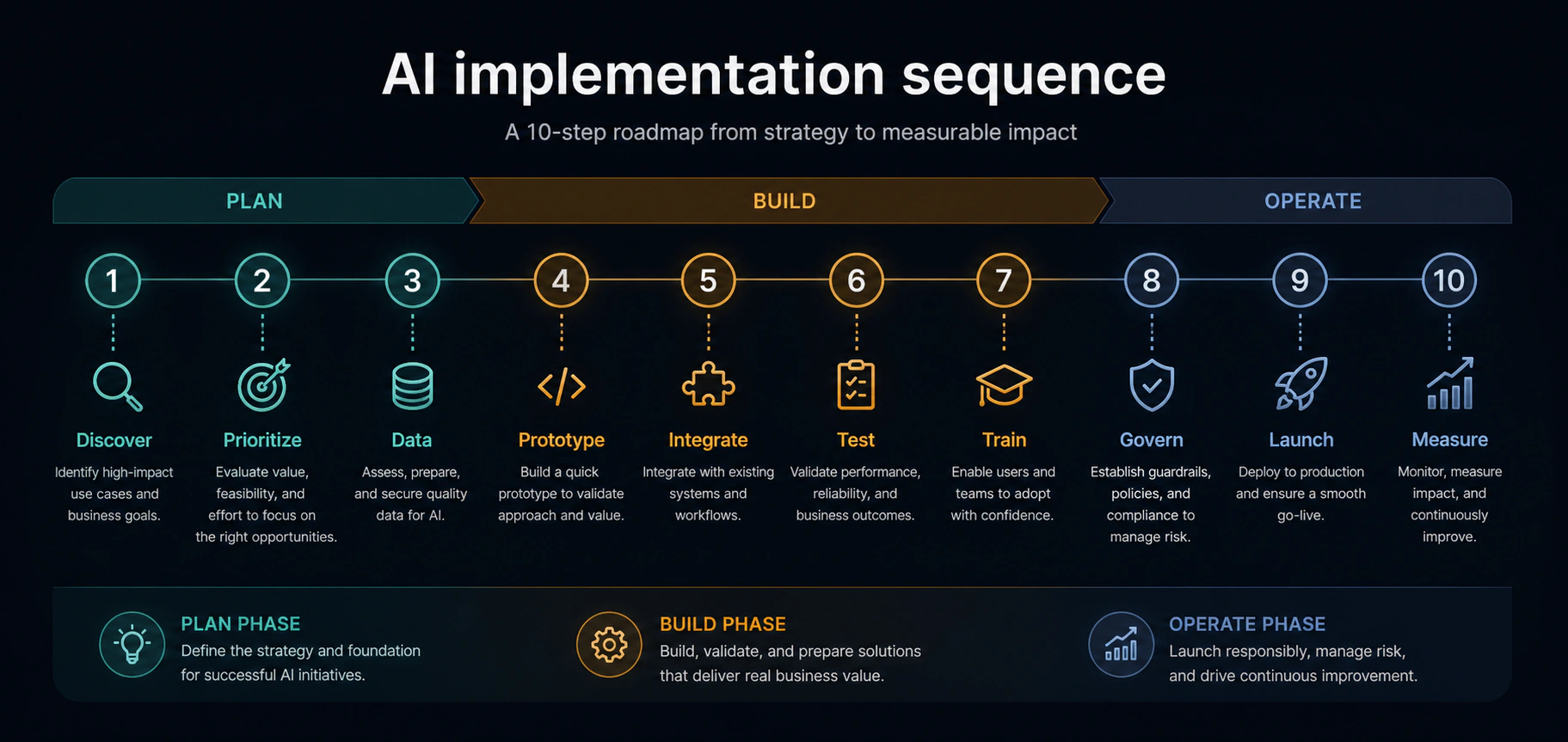
Figure 3. A simplified view of the implementation sequence in three phases: Plan (discover, prioritize, data), Build (prototype, integrate, test, train) and Operate (govern, launch, measure). It shows order only, not durations.
Common Pitfalls and How to Avoid Them
A 2024 RAND report says that, by some estimates, more than 80% of AI projects fail, twice the rate of IT projects without AI.8 From interviews with 65 experienced data scientists and engineers, it names five root causes.
| Pitfall | Mitigation |
|---|---|
| The problem is misunderstood or miscommunicated | One sentence with a number and an owner (step 1); criteria signed before the pilot (step 6). |
| Not enough data to train an effective model | Check a real, labeled sample before you commit (step 4). |
| Focus on the latest technology over users’ real problems | Root cause first; try a checklist, rule or training before AI (step 1). |
| Inadequate infrastructure to manage data and deploy models | Plan integration, monitoring and releases before scaling (step 7). |
| The problem is too difficult for AI | A contained pilot with known good and bad examples; accept “stop” (steps 5–6). |
In S&P Global Market Intelligence’s 2025 survey, 42% of companies abandoned most of their AI initiatives, up from 17% a year earlier. The average organization scrapped 46% of its AI proofs of concept before production.9
Conclusion
For mid-sized, non-tech enterprises, AI is a pragmatic lever, not futuristic hype. By following the 10-step roadmap, executives can:
- Get a measured go, fix or stop answer from one contained pilot before any rollout.
- Build internal capabilities step by step, with each spend tied to a decision gate.
- Set owners, criteria, checks and a written policy before scale makes them hard to add.
Adopt, adapt and iterate, one measured problem at a time.
Footnotes
-
BCG, “AI Adoption in 2024: 74% of Companies Struggle to Achieve and Scale Value” (press release), 2024. https://www.bcg.com/press/24october2024-ai-adoption-in-2024-74-of-companies-struggle-to-achieve-and-scale-value ↩
-
NIST Manufacturing Extension Partnership (MEP), “Artificial Intelligence: Key Consideration and Effective Implementation Strategies” (white paper), 2025. https://www.nist.gov/document/artificial-intelligence-key-consideration-and-effective-implementation-strategies ↩
-
MITRE, “MITRE’s Artificial Intelligence Maturity Model: A Roadmap for Successful AI Adoption” (fact sheet), 2024. https://www.mitre.org/sites/default/files/2024-06/PR-24-1492-AI-Maturity-Model-6-24-factsheet.pdf ↩
-
Deloitte, “AI ROI: The paradox of rising investment and elusive returns”, 2025. https://www.deloitte.com/global/en/issues/generative-ai/ai-roi-the-paradox-of-rising-investment-and-elusive-returns.html ↩
-
Vorne Industries (OEE.com), “OEE Calculation: Definitions, Formulas, and Examples”, accessed 2026. https://www.oee.com/calculating-oee/ ↩
-
ISO, “ISO/IEC 42001:2023 Information technology — Artificial intelligence — Management system”, 2023. https://www.iso.org/standard/42001 ↩
-
European Commission, “AI Act” (Regulation (EU) 2024/1689), page updated 2026. https://digital-strategy.ec.europa.eu/en/policies/regulatory-framework-ai ↩
-
RAND Corporation, “The Root Causes of Failure for Artificial Intelligence Projects and How They Can Succeed: Avoiding the Anti-Patterns of AI” (RR-A2680-1), 2024. https://www.rand.org/pubs/research_reports/RRA2680-1.html ↩
-
S&P Global Market Intelligence survey, reported by CIO Dive, “AI project failure rates are on the rise: report”, 2025. https://www.ciodive.com/news/AI-project-fail-data-SPGlobal/742590/ ↩